Home › Thao Suranari
Thao Suranari (Ya Mo), heroine of Nakhon Ratchasima
Thao Suranari is the title King Rama III gave to Khun Ying Mo, wife of the deputy governor of Nakhon Ratchasima, after the townspeople rose against the army of Chao Anouvong at Thung Samrit. The people of Korat call her Ya Mo, Grandmother Mo. This site is named Suranari after her, even though most of it is about the Nine Armies' War, which took place 41 years before her stand.
Khun Ying Mo before the war
She was born in 1771 in Nakhon Ratchasima, in a house opposite Wat Phra Narai Maharat, also called Wat Klang Nakhon, the daughter of Nai Kim and Nang Bunma. According to the traditional account she was fond of krabi-krabong, Thai sword-and-staff fighting, from childhood, rode elephants and horses with ease, and was a strong player of Thai chess.
She married Nai Thongkham, an official of Nakhon Ratchasima who later became Phraya Palat, the deputy governor, the post next below the governor. People called him Phraya Palat Thongkham. When Chao Anouvong's war broke out she was already about 55 or 56 years old.
The stand at Thung Samrit
In early 1827 the army of Chao Anouvong of Vientiane reached Nakhon Ratchasima while the governor and his deputy were away on duty in another town. It took the town and marched the townspeople off towards Vientiane. Khun Ying Mo was in the column of captive families. The deputy governor hurried back and pretended to go over to the invaders so that he could travel with his family.
At Thung Samrit, in the territory of Phimai, the townspeople rose against their guards and routed the force Chao Anouvong sent to put them down. The Royal Chronicle of the Third Reign says that Than Phu Ying Mo led the women as a reserve. Most Thai books give the date of the fight as 4 March. For the map and the details of the fighting, see the page for the Thung Samrit route.
Becoming Thao Suranari
When the war was over, King Rama III raised Khun Ying Mo to the rank of Thao Suranari on 30 October 1827 and gave her gold insignia of rank: a betel tray set, betel cups, a nest of small boxes, a lime pot, a water jar and a water bowl.
She and her husband built Wat Sala Loi outside the north-east corner of the town walls. She lived on in Nakhon Ratchasima until her death in April 1852, aged 81.
Her ashes and the monument
After her cremation, her husband built a chedi at Wat Sala Loi to hold her ashes. The chedi later fell into disrepair, and in 1899 Phraya Prasit Sanlakan, the provincial commissioner, built a new reliquary shrine for them at Wat Phra Narai Maharat.
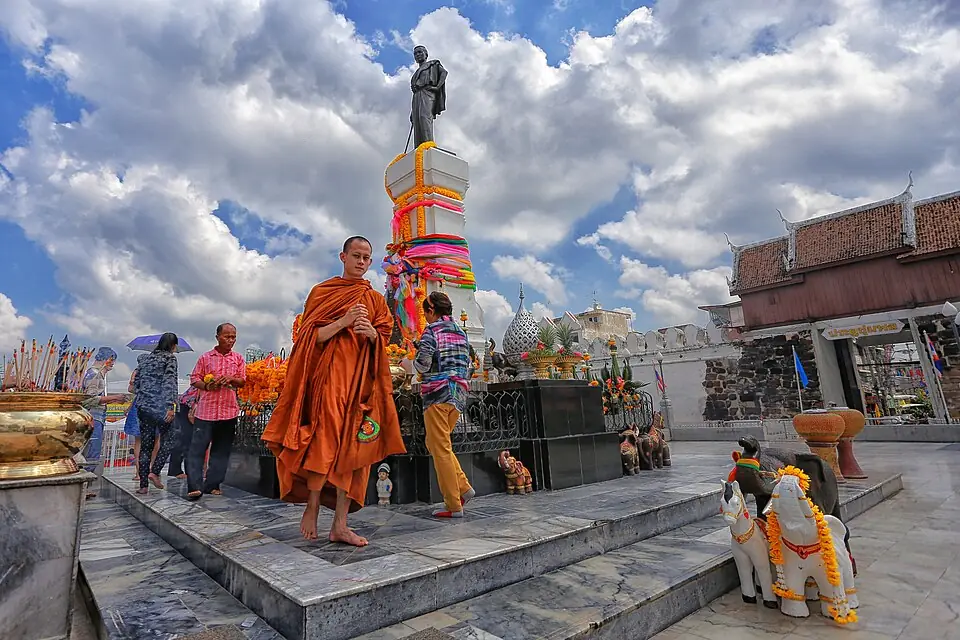
In 1933 officials and townspeople joined together to build a monument in front of Chumphon Gate. The Fine Arts Department assigned the design to Professor Silpa Bhirasri, working with Phra Thewaphinimmit. Cast in blackened copper, 1.85 metres tall and weighing 325 kilograms, it shows her standing in the dress of her rank, her right hand resting on a sword with its point to the ground and her left hand on her hip, facing west, the direction of Bangkok. It was unveiled in 1934 and her ashes were placed in its base. The present base was rebuilt in 1967.
In the footsteps of Ya Mo
Start at the monument and Chumphon Gate in the centre of town, then walk into the old town to Wat Phra Narai Maharat. From there go on to Wat Sala Loi, about 2 kilometres away. With another half day, drive about 60 kilometres to Phimai district to see Phimai Historical Park, stopping at the Thung Samrit memorial on the way.
The Thao Suranari victory festival is held in front of the provincial hall and around the monument from 23 March to 3 April every year.
Where historians still disagree
- Contemporary records do not name her: the testimony of Khun Ot and the official dispatches describing the fight at Thung Samrit mention the deputy governor, Phraya Yokkrabat, the town officials and the captive families fighting together, with monks, novices and women cheering them on in support, but they do not name Khun Ying Mo. Her name appears in the Royal Chronicle of the Third Reign and in the records of the suppression of the Vientiane rebellion.
- Prince Narisara Nuvadtivongs's remark: he asked why, if Than Phu Ying Mo did no more than lead the women as a rearguard, she is praised so highly.
- “Politics in the Thao Suranari Monument”: a thesis by Saipin Kaewngamprasert at Thammasat University argues that the stand really happened but was put to political use at the time the monument was built. When it was published as a book it angered many people in Nakhon Ratchasima, and the author was threatened.
- Srisakra Vallibhotama's view: the story of the stand may have been embellished later, on the basis of the real joint resistance of the people of Nakhon Ratchasima, with Thao Suranari as a cultural leader whom ordinary people revered.
- The date the monument was unveiled: sources differ, some giving 15 January and others 24 June 1934, so this site gives only the year.
Frequently asked questions
Who is Ya Mo?
She is Thao Suranari. Her birth name was Mo, and she was the wife of the deputy governor of Nakhon Ratchasima. She was given the title Thao Suranari for her part in the stand at Thung Samrit.
When was Thao Suranari born, and when did she die?
She was born in 1771 and died in April 1852, aged 81.
Where are Thao Suranari's ashes?
In the base of the monument in front of Chumphon Gate. Before that they were kept at Wat Sala Loi and then at Wat Phra Narai Maharat.
Was Thao Suranari in the Nine Armies' War?
No. The Nine Armies' War took place in 1785–1786, when she was about 15. Her stand came 41 years later, in a war with Vientiane.
Last updated 14 November 2026