Home › Campaign routes › The defence of Thalang: Thao Thep Krasattri and Thao Si Sunthon
The defence of Thalang: Thao Thep Krasattri and Thao Si Sunthon
A Burmese fleet of about 3,000 men, detached from the 1st army at Mergui, came down against the tin-mining towns of the Andaman coast. It took Takua Pa, Takua Thung and Pak Phra, then crossed over to besiege Thalang on the island of Phuket, a town whose governor had just died. The ones who rallied the townspeople to fight were Khun Ying Chan, the governor's widow, and her younger sister Khun Muk.
- 1Stops, numbered as in the list below
- 2Main battlefield
- 1–3Several stops close together: tap to zoom in
- ≈ approximate position
Press + to zoom in, then drag to move the map; on a phone you can pinch. Tap a number to read about that stop.
The mark ≈ means an approximate position. Borders on the map are present-day borders, shown only to help you find places. The routes are approximate lines drawn from the chronicles and later studies, not the actual path step by step. Dashed lines are enemy armies; solid lines are Siamese armies.
Why Burma wanted Thalang
Thalang was a source of tin and a port where foreign trading ships called. Whoever held it gained both revenue and a way to buy weapons. So the Burmese fleet made for it once it had swept up all the small towns along the coast.
At that moment Thalang was at its weakest. The governor had just died, no new governor had yet been appointed, and no army from Bangkok or Nakhon Si Thammarat could come to its aid.
The townspeople's camps
Khun Ying Chan, Khun Muk and the deputy governor, Phra Palat Thongphun, called up the townspeople, men and women alike, and built several camps: at Ban Khai, at Wat Phra Nang Sang, and at Thung Nang Dak, where the cannon named Phra Phirun Sanghan was mounted. The Burmese landed and built their siege camps on the other side.
The Burmese attacked the camps several times but could not break them. After a little over a month the supplies they had brought by ship ran out, while the townspeople had begun to go out and attack the Burmese camps themselves. On 13 March 1786 the Burmese took to their ships and withdrew.
After the war
Thalang escaped the enemy but was badly damaged. Fields and mines lay abandoned and the people went hungry. Letters that Khun Ying Chan and the town officials wrote to Francis Light, an English trader, describe the hardship of those days and ask to buy rice and weapons.
In Bangkok the king made Khun Ying Chan Thao Thep Krasattri and Khun Muk Thao Si Sunthon. The two titles remain the names of subdistricts, roads and bridges in Phuket to this day.
The route in 5 stops
Dates on this page are in the Common Era. Thai sources date the war in the Buddhist Era, and old documents began the new year around April, so they count the events of January to March 1786 (BE 2329) as still falling in BE 2328. That is why many Thai books place the whole Nine Armies' War in BE 2328 (1785).
- 1
Mergui (base of the 1st army)
Yi Wun led a fleet of about 3,000 men out of Mergui and down the Andaman coast. Its targets were the tin-mining towns: Takua Pa, Takua Thung and Thalang.
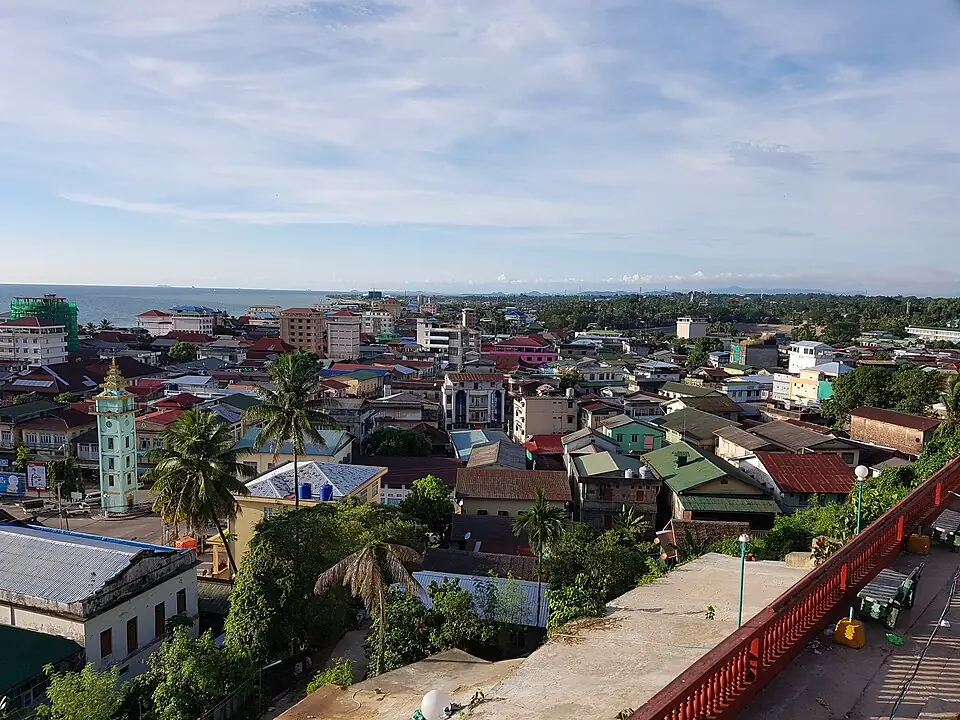
Myeik (Mergui), a port on Myanmar's Andaman coast · Photo: Kyaw_Zin_Win(KT) · CC BY-SA 4.0 via Wikimedia Commons A port town on the Andaman coast in the far south of Myanmar, today called Myeik. In the Ayutthaya period it was a Siamese port; it was lost to Burma in 1765. In the Nine Armies' War the 1st army was based here from mid-1785 to stockpile supplies, then split into a land force and a fleet to attack Siam's southern towns.
- 2
Takua Pa
The Burmese fleet took Takua Pa, then Takua Thung, the next town down the coast. Both were small tin-mining towns without the strength to fight a fleet.
Takua Pa is an old tin-mining town on the Andaman coast. In the old town, Si Takua Pa Road is still lined with Sino-European shophouses, and there is a walking street on Sundays in the tourist season.
Places to visit nearby
- Takua Pa old town, Si Takua Pa Road ↗Google Maps
- Phang Nga storiessongkran.com
Where to eat nearby
- Restaurants around this stop ↗Google Maps
- 3
Pak Phra (the strait leading to Thalang island)
The Burmese took Pak Phra. Khun Ying Chan was being held at Pak Phra at the time over a legal case. When Pak Phra fell she was able to cross back to Thalang just before the Burmese followed, at about the same time as her husband, the governor of Thalang, fell ill and died.
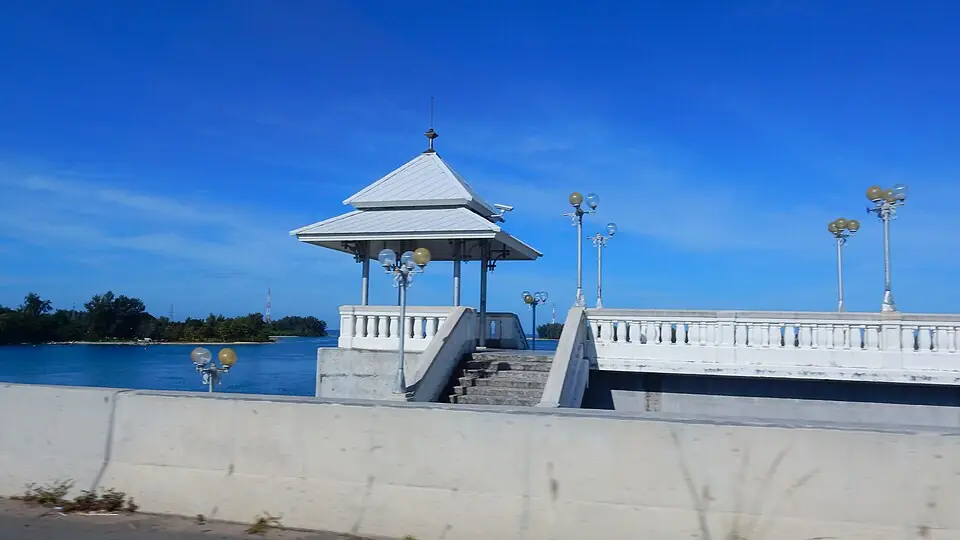
Sarasin Bridge, across the Pak Phra strait between Phang Nga and Phuket island · Photo: Roma Neus · CC BY 3.0 via Wikimedia Commons The Pak Phra Strait is the narrow channel between the mainland of Phang Nga and the island of Phuket. Today it is crossed by Sarasin Bridge and a parallel pair of bridges named Thao Thep Krasattri Bridge and Thao Si Sunthon Bridge. The old Sarasin Bridge is open for walking, for the view and the sunset.
Places to visit nearby
- Sarasin Bridge ↗Google Maps
- Mai Khao Beach ↗Google Maps
- Phang Nga storiessongkran.com
Where to eat nearby
- Restaurants around this stop ↗Google Maps
- 4
Tha Ruea (Thao Thep Krasattri and Thao Si Sunthon Monument)
The Burmese landed on the island at Tha Ruea Taphao and built camps to besiege Thalang at Pak Chong, Na Khok and Na Klang.

The Heroines' Monument to Thao Thep Krasattri and Thao Si Sunthon, Thalang district, Phuket · Photo: Sry85 · CC BY 3.0 via Wikimedia Commons The monument is a cast statue of the two women standing with swords on a tall plinth in the middle of the roundabout on Thep Krasattri Road (Highway 402), the main road from the airport into Phuket town. It was completed in 1967, and Phuket people and visitors alike stop to pay their respects. About 300 metres away along Pa Khlok Road is Thalang National Museum, which tells the story of the defence of Thalang and the history of Phuket island.
Places to visit nearby
- Thao Thep Krasattri and Thao Si Sunthon Monument ↗Google Maps
- Thalang National Museum ↗Google MapsAbout 300 m from the monument
- Phuket storiessongkran.com
Where to eat nearby
- Phuket Old Town, Thalang Road ↗Google MapsLocal Phuket food, about 12 km away
- Restaurants around this stop ↗Google Maps
- 5
Thalang town (the camp at Wat Phra Nang Sang)
Thalang had no governor, and no army came from Bangkok to help, because every available force was tied down at Kanchanaburi and in the north. The townspeople had to defend the town themselves.
Main battlefield of this campaign- Against
- A Burmese fleet of about 3,000 men under Yi Wun
- Where
- Thalang town at Ban Don; the camps at Ban Khai, Wat Phra Nang Sang and Thung Nang Dak
- How
- Khun Ying Chan, Khun Muk and the deputy governor Thongphun gathered the townspeople, men and women, and built camps. They used the cannon mounted in the camps to hold the enemy off, held the camps every time the Burmese attacked, and went out to attack the Burmese camps when the enemy weakened.
- Outcome
- The fighting lasted a little over a month. Short of supplies and unable to take the town, the Burmese took to their ships and withdrew on 13 March 1786.
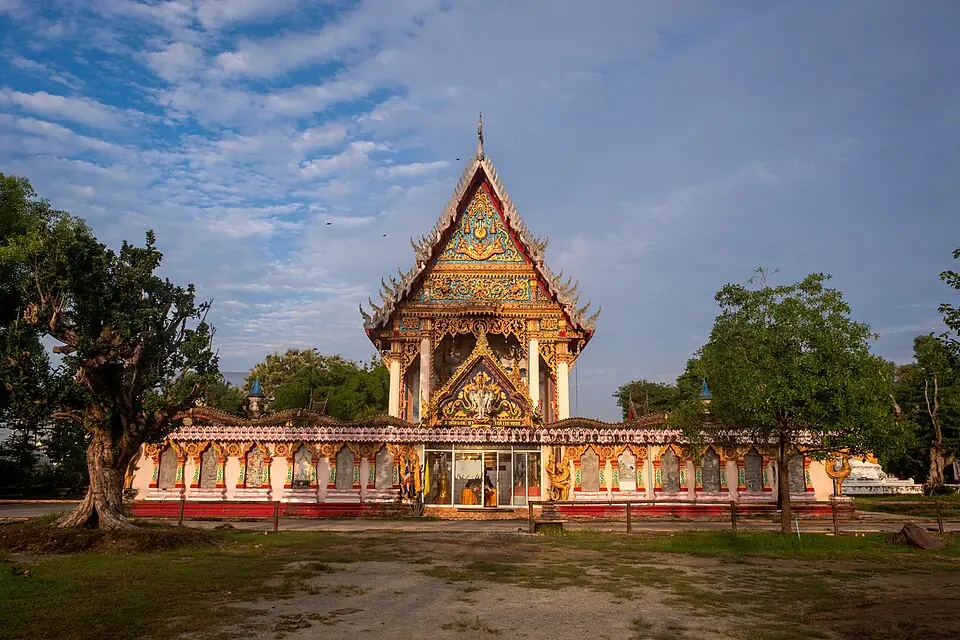
Wat Phra Nang Sang, Thalang district, where the people of Thalang made their camp in 1786 · Photo: Shane WP Wongperk · CC BY-SA 4.0 via Wikimedia Commons Wat Phra Nang Sang is one of Phuket's oldest temples, beside Thep Krasattri Road near the Thalang district intersection, with an old ordination hall and ancient Buddha images. Not far away are Wat Phra Thong, where a Buddha image rises half-buried from the ground, and the Thalang Memorial, the grounds where the province holds the Thalang Victory festival around 13 March every year.
Places to visit nearby
- Wat Phra Nang Sang ↗Google Maps
- Wat Phra Thong (Phra Phut, the half-buried Buddha) ↗Google Maps
- Thalang Memorial ↗Google Maps
- Phuket storiessongkran.com
Where to eat nearby
- Phuket Old Town, Thalang Road ↗Google Maps
- Restaurants around this stop ↗Google Maps
Travel guides for the provinces on this route
Things to do and where to eat in each province, from songkran.com, our sister travel site
- Phang NgaStop 2, 3Phang Nga stories →
- PhuketStop 4, 5Phuket stories →
Where historians still disagree
- Women dressed as men and carrying coconut fronds: this is a local tradition. It does not appear in the royal chronicle, which says only that the two women took counsel with the town officials and set up camps to defend the town.
- Tha Ruea Taphao and the sites of the camps: the village names in the chronicle and the records can be matched to areas of today's Thalang district, not to exact spots.
- The name Thung Nang Dak: some documents write Thung Nang Tak.
Frequently asked questions
What day is Thalang Victory Day?
13 March, the day the Burmese withdrew from Thalang in 1786. Phuket province holds a commemoration every year.
How were Thao Thep Krasattri and Thao Si Sunthon related?
They were sisters. Thao Thep Krasattri was Khun Ying Chan, wife of the governor of Thalang. Thao Si Sunthon was Khun Muk, her younger sister.
Where is the monument?
In the middle of the Tha Ruea roundabout on Thep Krasattri Road, Thalang district, Phuket, near Thalang National Museum.
Was the defence of Thalang part of the Nine Armies' War?
Yes. The fleet that attacked Thalang was part of the 1st of King Bodawpaya's nine armies.
Last updated 14 November 2026