Home › Heroines
The heroines of early Bangkok: Thao Thep Krasattri, Thao Si Sunthon and Thao Suranari
Suranari means “brave woman”. In the early Bangkok era three women were given noble titles for defending their towns in wartime. The first two were sisters from Thalang, in the Nine Armies' War. The third was Khun Ying Mo of Nakhon Ratchasima, 41 years later. People often mix up who fought whom, so this page sets the two stories side by side.
Two wars, three heroines
The defence of Thalang was part of the Nine Armies' War. The enemy was a Burmese fleet of about 3,000 men, detached from the 1st army to attack the towns of the Andaman coast. It took place between February and March 1786, in the reign of King Rama I.
The stand at Thung Samrit took place in early 1827, in the reign of King Rama III. The enemy was the army of Chao Anouvong of Vientiane. It had nothing to do with Burma or with the Nine Armies' War. At the time of the fighting at Thalang, Khun Ying Mo was still a girl of about 15 in Nakhon Ratchasima.
| Thao Thep Krasattri | Thao Si Sunthon | Thao Suranari | |
|---|---|---|---|
| Birth name | Chan (Khun Ying Chan) | Muk (Khun Muk) | Mo (Khun Ying Mo) |
| Town | Thalang, today's Phuket | Thalang, today's Phuket | Nakhon Ratchasima |
| Position when the war came | Wife of the governor of Thalang, who had just died | Younger sister of Khun Ying Chan | Wife of the deputy governor of Nakhon Ratchasima |
| War | The defence of Thalang, in the Nine Armies' War | The defence of Thalang, in the Nine Armies' War | Thung Samrit, in Chao Anouvong's war; not the Nine Armies' War |
| When | February – 13 March 1786 | February – 13 March 1786 | Early March 1827 (BE 2369 in most Thai books, by the old calendar) |
| Enemy | A Burmese fleet of about 3,000 men | A Burmese fleet of about 3,000 men | The Vientiane army of Chao Anouvong |
| Reign | King Rama I | King Rama I | King Rama III |
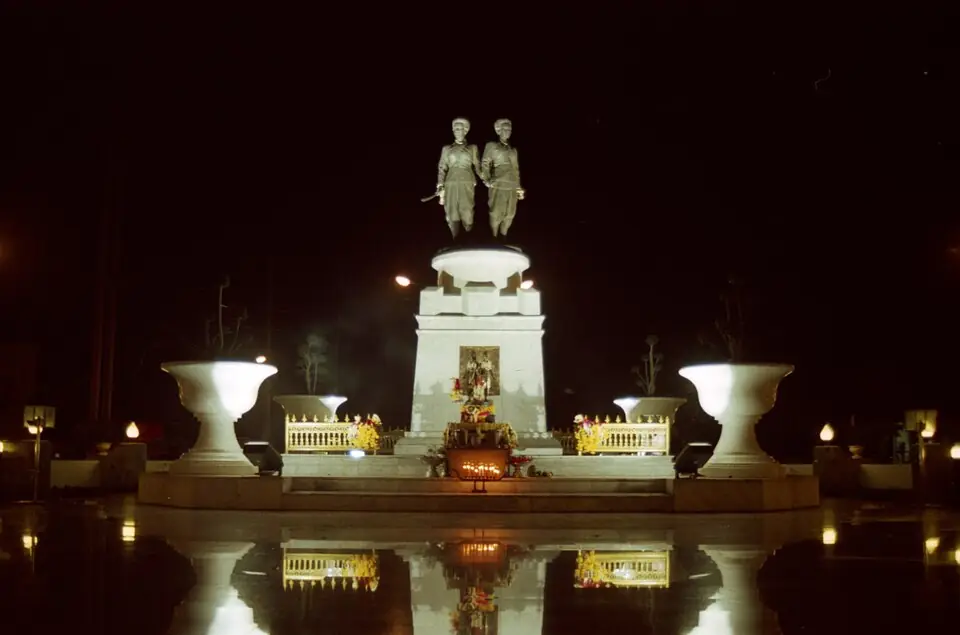
| Monument | Tha Ruea roundabout, Thalang district, Phuket | Tha Ruea roundabout, Thalang district, Phuket | In front of Chumphon Gate, Nakhon Ratchasima |
What the two stories share
Both towns were without a leader when the enemy arrived. At Thalang the governor had just died. At Nakhon Ratchasima the governor and his deputy were away on duty in another town. So those who stood up and rallied the people were the wives of the town's officials, together with the officials who remained.
In both stories the main force was ordinary townspeople, men and women, not an army from the capital. And in both, the most widely told details are the very parts that contemporary records do not mention, such as the women carrying coconut fronds at Thalang, or Nang Sao Bunluea at Thung Samrit. When reading about the heroines, it helps to tell apart what comes from documents and what comes from later storytelling.
Where to pay respects and learn more
In Phuket, the Thao Thep Krasattri and Thao Si Sunthon Monument stands in the middle of the Tha Ruea roundabout in Thalang district. Close by are Thalang National Museum and Wat Phra Nang Sang, once the site of a camp. The province holds the Thalang Victory festival around 13 March every year.
In Nakhon Ratchasima, the Thao Suranari Monument stands in front of Chumphon Gate in the centre of town, and a victory festival is held from 23 March to 3 April. In Phimai district there is the Thung Samrit memorial.
Frequently asked questions
Did Thao Suranari fight the Burmese?
No. Thao Suranari took part in the fight against the army of Chao Anouvong of Vientiane at Thung Samrit in early 1827. Those who fought the Burmese were Thao Thep Krasattri and Thao Si Sunthon at Thalang, in the Nine Armies' War.
Who was born first?
Khun Ying Chan was born around 1735 and Khun Muk a few years after her. Khun Ying Mo was born in 1771.
What does Suranari mean?
It means “brave woman”, from sura, brave, and nari, woman.
- Thao Thep Krasattri and Thao Si Sunthon – Wikipedia
- Nine Armies' War – Thai Wikipedia, citing the Royal Chronicle of Rattanakosin, First Reign, and Thai Rop Phama (in Thai)
- Thao Suranari – Thai Wikipedia (in Thai)
- A study of beliefs about Thao Suranari (Ya Mo) and of the ways people fulfil their vows to her – Nakhon Ratchasima Rajabhat University (in Thai)
Last updated 14 November 2026