Home › Campaign routes › The stand at Thung Samrit: Thao Suranari and the people of Korat
The stand at Thung Samrit: Thao Suranari and the people of Korat
This story is not part of the Nine Armies' War. It took place 41 years later, in the reign of King Rama III, and the enemy was not Burma. We include it on this site because it is the origin of the name Suranari. When the army of Chao Anouvong of Vientiane took Nakhon Ratchasima and marched its people away, the captive families of Korat rose against their guards at Thung Samrit, and Khun Ying Mo, wife of the deputy governor, was honoured as Thao Suranari.
- 1Stops, numbered as in the list below
- 2Main battlefield
- 1–3Several stops close together: tap to zoom in
- ≈ approximate position
Press + to zoom in, then drag to move the map; on a phone you can pinch. Tap a number to read about that stop.
The mark ≈ means an approximate position. Borders on the map are present-day borders, shown only to help you find places. The routes are approximate lines drawn from the chronicles and later studies, not the actual path step by step. Dashed lines are enemy armies; solid lines are Siamese armies.
Why Chao Anouvong marched
Vientiane had been a tributary state of Bangkok since the end of the Thonburi period, and many Lao had been carried off and resettled in Siam's inner provinces. Chao Anouvong wanted to take those people home and free Vientiane from its tributary status. The Thai royal chronicle says that a rumour had then reached Vientiane that the British, who had just defeated Burma, were about to attack Bangkok, and Chao Anouvong saw his chance.
Thai history calls these events the Anouvong Rebellion. Lao history regards them as a war of independence and honours Chao Anouvong as a hero king. Anyone reading about them should know that there are two points of view.
From the captured town to Thung Samrit
The Vientiane army entered Nakhon Ratchasima easily, because the town's forces were away on duty elsewhere. The townspeople were divided into columns and marched north under Lao guards. The column of the town officials and their families halted at Thung Samrit, near Phimai.
There the townspeople, led by the deputy governor and the officials, planned an uprising. They killed almost all of their guards, then built a camp and beat back the force Chao Anouvong sent to put them down. The episode cost Chao Anouvong both men and time, and when the army from Bangkok came up he had to withdraw from Nakhon Ratchasima.
Khun Ying Mo becomes Thao Suranari
The Royal Chronicle of the Third Reign says that Than Phu Ying Mo, wife of the deputy governor, led the women as a reserve in the fight at Thung Samrit. King Rama III later made her Thao Suranari and gave her gold insignia of rank. Thai books give the date of her elevation as 30 October 1827.
About a hundred years later, in 1934, the people of Nakhon Ratchasima joined together to build her monument in front of Chumphon Gate. It is counted as the country's first monument to a woman commoner, and she became Ya Mo, the figure who unites the people of Korat to this day.
The route in 3 stops
Dates on this page are in the Common Era. The events took place in February–March 1827 (BE 2370), but old documents, which began the new year around April, count them as still falling in BE 2369. That is why the monument and most Thai books give the year as BE 2369 (1826).
- 1
Vientiane
Chao Anouvong, king of Vientiane, a vassal state of Bangkok, brought his army down across the Mekong, telling the towns along the way that he was going to help Bangkok fight the British. He was therefore able to march through the towns of the north-east with no one to stop him.
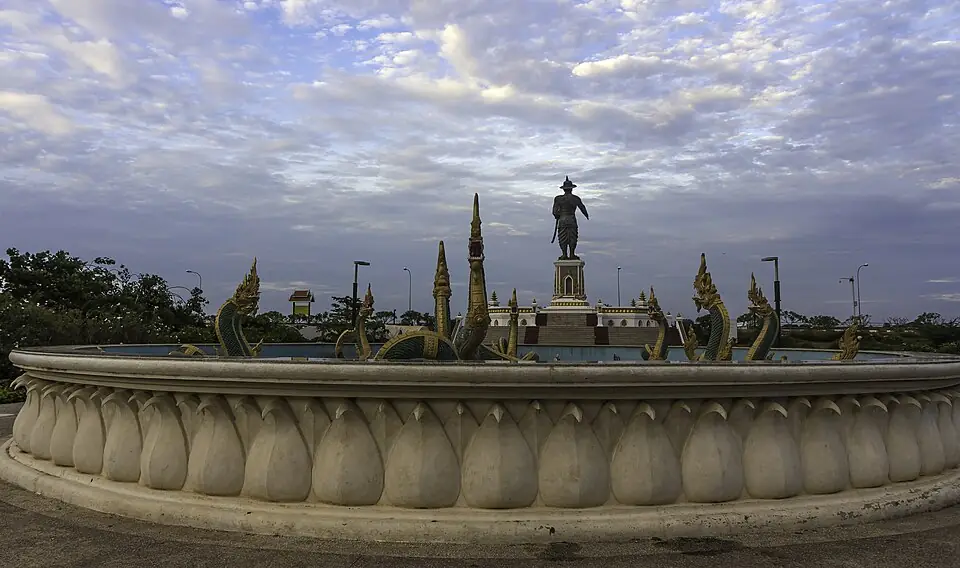
The Chao Anouvong statue beside the Mekong, Vientiane · Photo: Stefan Fussan · CC BY-SA 3.0 via Wikimedia Commons The capital of the Lao kingdom of Lan Xang Vientiane, a tributary state of Bangkok from 1779. Today it is the capital of Laos, on the Mekong River opposite Nong Khai province. A statue of Chao Anouvong stands in the park along the Mekong. In Lao history he is a hero king who tried to win back independence.
- 2
Nakhon Ratchasima town
The royal chronicle says the Vientiane army reached Nakhon Ratchasima while the governor and the deputy governor, Phraya Palat, were away on official business at Khukhan, so it took the town easily and then drove the townspeople, men, women and children, up towards Vientiane. When Phraya Palat heard the news he came back and pretended to join the invaders, so that he could travel with the families.
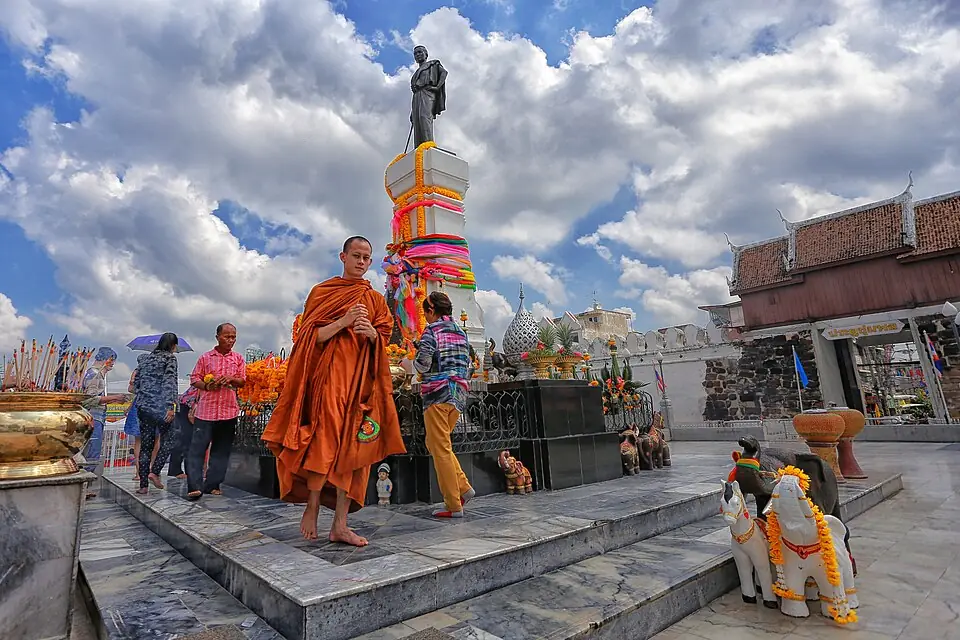
The Thao Suranari Monument in front of Chumphon Gate, Nakhon Ratchasima · Photo: Yakuzakorat · CC BY-SA 3.0 via Wikimedia Commons The Thao Suranari Monument stands in front of Chumphon Gate, the town's west gate. Cast in blackened copper and 1.85 metres tall, it shows her standing with her right hand on a sword, facing towards Bangkok. It was designed by Professor Silpa Bhirasri with Phra Thewaphinimmit and unveiled in 1934, and her ashes are kept in its base. The people of Korat come to pay their respects all day long, and the Thao Suranari victory festival is held from 23 March to 3 April every year.
Places to visit nearby
- Thao Suranari Monument and Chumphon Gate ↗Google Maps
- Wat Sala Loi ↗Google MapsThe temple Thao Suranari built
- Wat Phra Narai Maharat (Wat Klang Nakhon) ↗Google Maps
- Things to do in Nakhon Ratchasimasongkran.com
Where to eat nearby
- Mae Kim Heng Market ↗Google MapsKorat-style fried noodles (phat mi Korat) and other local food
- Where to eat in Nakhon Ratchasimasongkran.com
- Restaurants around this stop ↗Google Maps
- 3
Thung Samrit
The column of the town officials' families stopped to rest at Thung Samrit. The royal chronicle says Phraya Palat asked for some of the knives, axes and guns to be given back, claiming they were needed to hunt for food for the families on the way. Most books date the battle to 4 March.
Main battlefield of this campaign- Against
- About 200 Vientiane soldiers guarding the column, and a force of about 2,000 that Chao Anouvong sent to put the rising down
- Where
- Thung Samrit, in the territory of Nakhon Ratchasima, today in Phimai district
- How
- The townspeople rose together at first light. The men went into the fight, while the women, monks and novices shouted in support. The royal chronicle says Than Phu Ying Mo commanded the women as a reserve.
- Outcome
- Almost all the guards were killed, and the force sent after them to put the rising down was routed and fell back. When the army from Bangkok marched up, Chao Anouvong withdrew from Nakhon Ratchasima.
At Ban Samrit is the Thung Samrit memorial, with a shrine to the spirits of Nang Sao Bunluea and those who fought beside her. The villagers hold a commemoration at the beginning of March every year. From here it is about 20 minutes to Phimai Historical Park.
Position on the map: Approximate coordinates of the Ban Samrit area, Samrit subdistrict, Phimai district.
Places to visit nearby
- Thung Samrit memorial ↗Google Maps
- Phimai Historical Park ↗Google MapsThe Khmer temple of Phimai, about 15 km away
- Sai Ngam banyan grove, Phimai ↗Google Maps
- Things to do in Nakhon Ratchasimasongkran.com
Where to eat nearby
Travel guides for the provinces on this route
Things to do and where to eat in each province, from songkran.com, our sister travel site
- Nakhon RatchasimaStop 2, 3Things to do in Nakhon Ratchasima →Where to eat in Nakhon Ratchasima →
Where historians still disagree
- Khun Ying Mo's role: the contemporary testimonies and dispatches that describe the fighting, such as the testimony of Khun Ot, do not mention her name. It appears in the Royal Chronicle of the Third Reign and in the records of the suppression of the Vientiane rebellion, as the leader of the women's reserve. Historians therefore disagree about how large her real role was.
- Nang Sao Bunluea: the story of the young woman who set fire to the gunpowder carts and died in the blast has not yet been found in any document written before 1932.
- The politics of the monument: a study by Saipin Kaewngamprasert argues that the stand really happened but was magnified for political ends at the time the monument was built. When it was published as a book there were fierce protests in Nakhon Ratchasima.
- The Lao view: Lao history tells the events of the same period as a war of independence, not a rebellion.
- BE 2369 or BE 2370: the events took place in early 1827. Under the old calendar that was still BE 2369; by the modern count it is BE 2370.
Frequently asked questions
Did Thao Suranari have anything to do with the Nine Armies' War?
No. The stand at Thung Samrit took place in the reign of King Rama III, in early 1827, 41 years after the Nine Armies' War, and it was fought against the army of Vientiane, not Burma. At the time of the Nine Armies' War Khun Ying Mo was about 14 or 15.
Where is Thung Samrit?
In Samrit subdistrict, Phimai district, Nakhon Ratchasima province, about 45 kilometres from Nakhon Ratchasima town. The Thung Samrit memorial is there.
Who was Thao Suranari?
She was Khun Ying Mo, wife of the deputy governor of Nakhon Ratchasima, born in 1771 and died in 1852. The people of Korat call her Ya Mo.
Where is the Thao Suranari Monument?
In front of Chumphon Gate in the centre of Nakhon Ratchasima. It was unveiled in 1934, and her ashes are kept in its base.
Last updated 14 November 2026